On March 15, 1908, Mabel Allen Sleeper reflected on the years she had spent organizing women in Beloit. She credited the city’s federation of women with having “secured a public library, public kindergarten, and all sorts of educational advantages.”
Sleeper understood organization unusually well. Before coming to Beloit, she and her husband had spent five years as missionaries in Bulgaria. She taught children, adapted books for young readers, trained women in practical household skills, and helped edit a mission newspaper distributed through schools and the Bulgarian army.
When Sleeper arrived in Beloit, women did not possess full voting rights. They could not participate in city and state government on equal terms with men, but they could form organizations, raise money, circulate petitions, attend public meetings, and make it increasingly difficult for elected officials to ignore them.
On May 17, 1894, Sleeper brought representatives of nine Beloit women’s clubs together to create the City Federation of Women’s Clubs. Its constitution and bylaws were adopted that November, and Sleeper became the organization’s first president.
The participating clubs included the Beloit Club, West Side Monday Club, Arche, Fortnightly, Friendly Room Reading Circle, L.H. Musical, Saturday Club, Social Reading Club, and Tuesday Club. Individually, these organizations had limited reach. Acting together, they could speak for a sizable and increasingly influential portion of the city.
Their original objectives read less like the plans of a social club and more like a blueprint for municipal development.
They wanted better public schools, domestic science instruction, public lectures, a permanent free library, free concerts, and a downtown clubroom where women could organize their work.
Careful comparison of the historical sources changes one part of this story. A later Beloit Historical Society account credits the federation with introducing kindergarten to Beloit, but a 1908 history written with information from school board secretary E.C. Helm dates Beloit’s public kindergartens to 1892, two years before the federation was organized.
The federation therefore did not create Beloit’s first public kindergarten. It did, however, become an important champion of early childhood education. By 1896, the kindergarten program had become so popular that double sessions were needed. By 1908, Beloit had five separate kindergarten buildings, four of them constructed specifically for that purpose.
The library story requires similar care. Organized library service had existed in Beloit since 1859, long before the federation was created. Nevertheless, an 1898 national history of the women’s club movement reported that the Beloit federation had “secured a city library” and exercised considerable influence over educational matters.
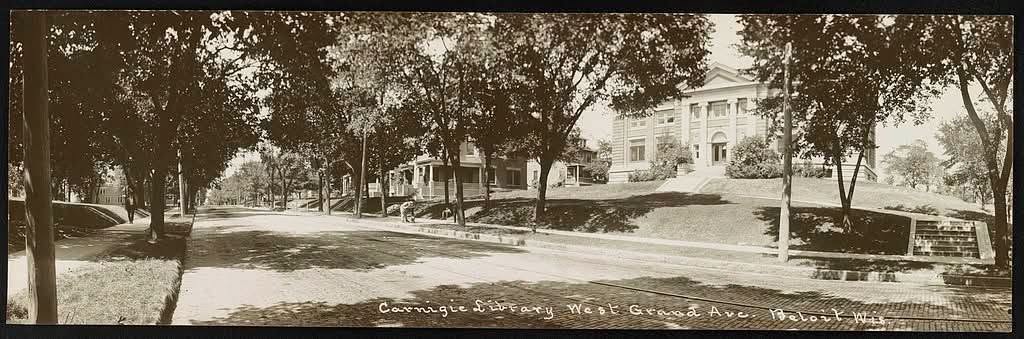
In 1901, Beloit received a $25,000 grant from Andrew Carnegie for a dedicated free public library building, which opened in 1903. Civic institutions are rarely created by one person at one meeting. They emerge because people keep advocating, raising money, recruiting supporters, and pressing public officials until an uncertain idea becomes an established part of the city.
The federation’s work soon extended beyond education and the library. Its surviving records, summarized by the Beloit Historical Society, credit members with traveling libraries, children’s story hours, reading material for soldiers during the Spanish-American War, and advocacy for free municipal garbage collection.
In 1908, federation representatives approached Wisconsin Senator Robert M. La Follette about tuberculosis legislation and treatment. Members also supported a state constitutional amendment that would extend voting rights to women. Their civic work was not a substitute for political equality. It was part of the campaign to obtain it.
The organization changed its name to the Beloit Federation of Women in 1911, allowing women to participate as individuals rather than only through established clubs. Membership grew from 147 women in 1913 to approximately 400 by 1930.
As Beloit grew, the federation supported parent-teacher organizations, parks, playgrounds, hospital development, public health programs, and other community improvements. It helped support the creation of Beloit’s Municipal Hospital in 1928. During the 1940s, members purchased a $495 infant respirator and contributed $105 for a room and shower for transient women at the Salvation Army.
In 1947, the federation helped organize the Beloit Junior Woman’s Club, giving a new generation of women its own path into community service. The Junior Woman’s Club continues that tradition today.
The Beloit Federation of Women finally dissolved in October 2011 after 117 years. In one of its final decisions, the remaining members gave $4,400 to the Beloit Historical Society and another $4,400 to the Beloit Public Library.
The symmetry is fitting. One gift helped preserve the women’s history. The other went to an institution they had spent decades championing.
These women were not necessarily quiet in their own time. They organized, petitioned, lobbied, raised money, challenged officials, and turned private concern into public action. What became quiet was their place in Beloit’s collective memory.
Image and sources
Historic view of the Carnegie Library on West Grand Avenue in Beloit. Sources described in this story include the Beloit Historical Society’s history of the federation, a 1908 history prepared with information from school board secretary E.C. Helm, an 1898 national history of the women’s club movement, and surviving federation records.