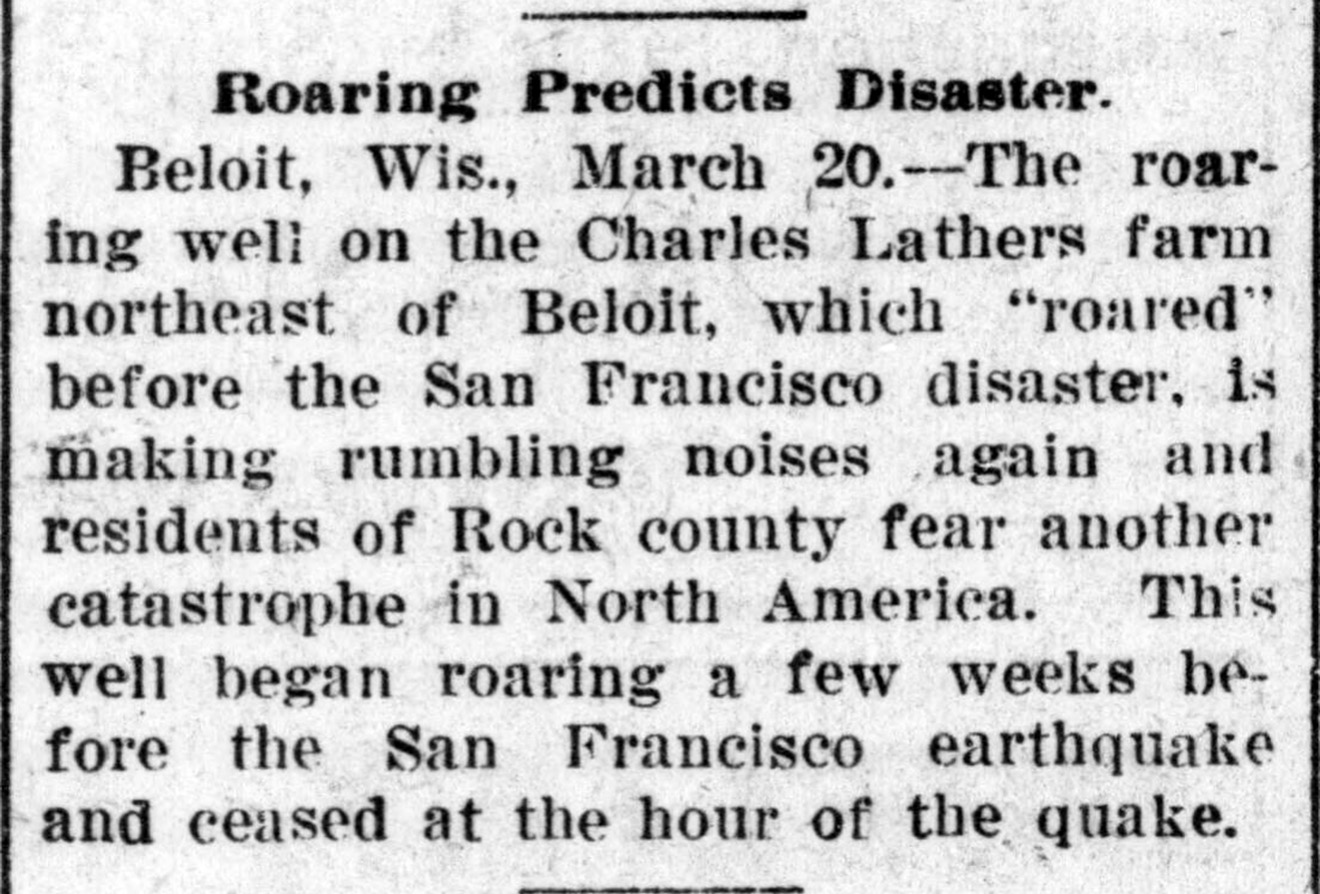
In 1908, a strange sound coming from a farm outside Beloit had people wondering if another earthquake was coming.
The farm belonged to Charles F. Lathers, about three miles outside Beloit. Lathers was a successful Turtle Township dairy farmer with 235 acres, around 60 Durham cows and a milk business that delivered roughly 400 quarts into Beloit every day. But in March 1908, it wasn’t the cows or the dairy business that suddenly had newspapers talking about his farm. It was his well.
On March 19, a news dispatch out of Beloit reported that the Lathers well had begun making rumbling noises while a strong current of air came from somewhere deep inside it. The story quickly traveled beyond Wisconsin, partly because people around Beloit apparently remembered something very similar happening two years earlier.
According to the story being told at the time, the well had started roaring several weeks before the great San Francisco earthquake of April 18, 1906. Then, at about the time the earthquake struck California, the strange activity at the well supposedly stopped.
Now it was March 1908, and the well was roaring again. A Wisconsin newspaper reported that the Lathers family feared another San Francisco-type earthquake might be coming, while other newspapers repeated the story and reported that people in the area were wondering whether some sort of calamity was on the way.
Then an earthquake struck Mexico. That was enough to turn an unusual local story into something much bigger. On April 8, a South Carolina newspaper ran the headline “EARTHQUAKE PREDICTED” and told readers that the strange well near Beloit had now supposedly predicted the Mexican earthquake just as people claimed it had predicted the San Francisco earthquake two years earlier.
A farm well outside Beloit had become, at least in the newspapers, a warning from deep inside the earth.
The story didn’t simply disappear with the newspapers. The following year, the Engineering and Mining Journal took an interest in the Beloit well while discussing whether underground pressure and the movement of air through wells might have some relationship to earthquakes. Charles Lathers himself provided information about the well, describing its water as clear and good and the air coming from it as cold and without any unusual odor.
The journal apparently wanted to know whether Lathers was someone whose account could be trusted, so Beloit postmaster L. F. Rosenthal was contacted. Rosenthal described Lathers as a well-known and prominent farmer and said his statements could be relied upon.
By then, the story had traveled well beyond Beloit and even beyond the United States. A Mexican scientific journal discussing the earthquakes of 1908 mentioned the strange phenomenon near Beloit and the “Roaring Well” on the Charles Lathers farm.
None of this means a well outside Beloit could actually predict earthquakes. There is no evidence that Charles Lathers had accidentally discovered an earthquake-warning system, and two unusual things happening around the same time doesn’t prove that one caused or predicted the other.
But the well was real, the strange reports about it were real, and so was the attention it received. Newspapers across the country were talking about it, an engineering journal investigated it, Beloit’s postmaster was asked to vouch for the farmer who owned it, and scientists in Mexico even knew about the strange well outside Beloit.
Somewhere just outside of Beloit was an otherwise ordinary dairy farm where cows needed milking and hundreds of quarts of milk still had to be delivered into town every day. But for a little while in 1908, when a well on Charles Lathers’ farm started roaring, people wondered if the earth itself was trying to tell Beloit something.
About the sources
This story draws on March and April 1908 newspaper reports, the February 20, 1909 issue of The Engineering and Mining Journal, and a Mexican scientific journal’s discussion of the 1908 earthquakes. The historic clipping shown above was supplied by Thomas Pullen.