In 1907, three years after John Paley died, the women in his family still held significant positions inside the Beloit State Bank. His daughter Clara helped manage its daily operations, his widow Henrietta helped govern it, and his daughter Annette owned part of it. Not one of them could vote for president.
Clara and Henrietta, who lived in Beloit, could not vote for Beloit’s city council either. Wisconsin women had regained a limited right to vote on school matters in 1901, but efforts to extend that right to other elective offices had failed. Ratification of the 19th Amendment was still thirteen years away.
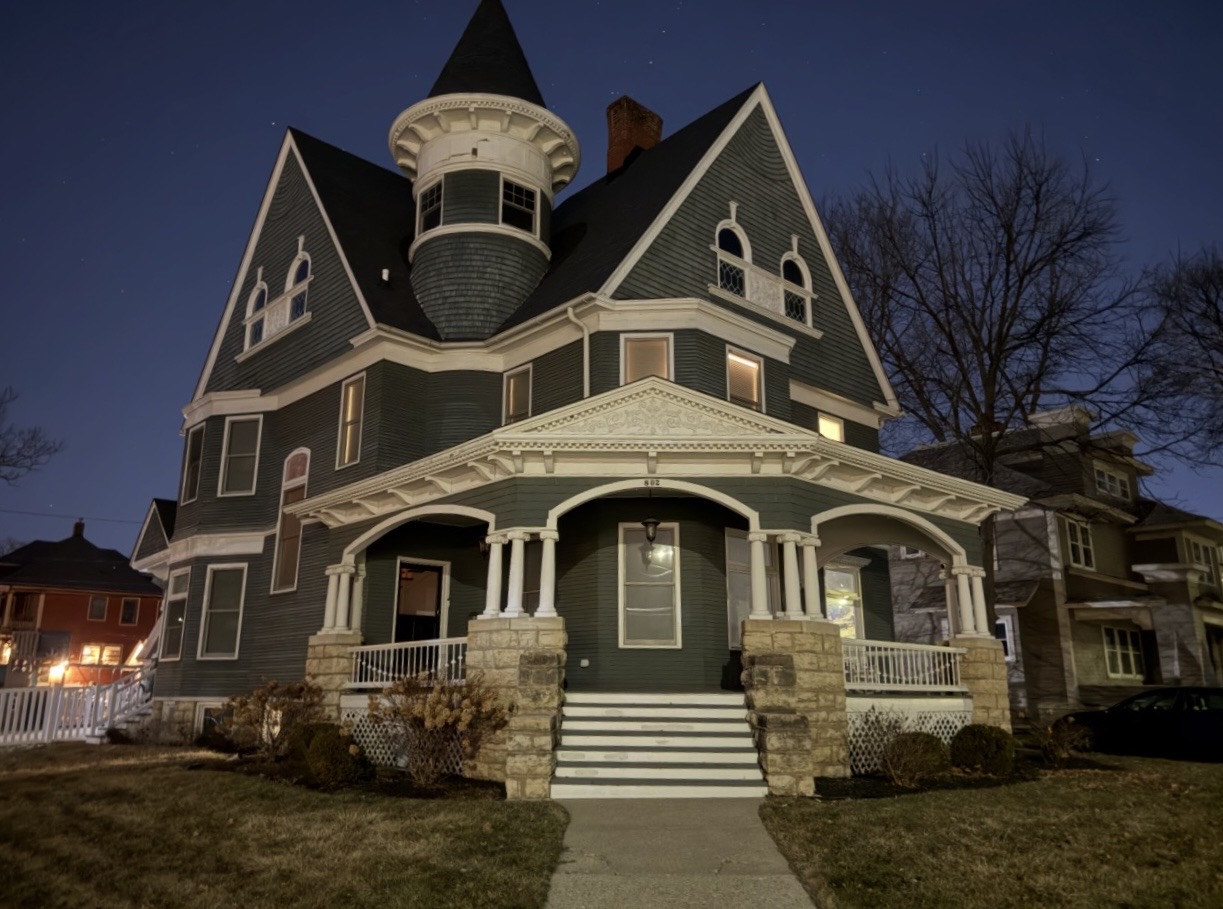
The family’s story survives at 802 Park Avenue in one of Beloit’s most spectacular homes. Built in 1895, the Paley House rises beneath steeply pitched gables with enormous shingled peaks, paired rounded windows, projecting bays and a broad veranda wrapped around its entrance. Above it all, a slender tower climbs past the roofline and ends beneath a sharply pointed conical roof.
Many longtime Beloiters also remember it as the Pumpkin House. For a time, its exterior was painted orange, turning an already unmistakable home into an even more memorable neighborhood landmark. The color eventually changed, but the nickname remained part of local memory.
The Wisconsin Historical Society describes the design as both animated and stately. The house remains a contributing property in Beloit’s Near East Side Historic District, and its unmistakable tower still helps define the neighborhood more than 130 years after it was built.
The house was constructed for John and Henrietta Paley. John had arrived in Beloit during the early 1890s and incorporated the Beloit State Bank in 1892 with associates from Mount Carroll and Morrison, Illinois. Three years later, the Paley family’s grand Queen Anne home rose on Park Avenue.
It would be easy to remember 802 Park simply as the mansion of a successful bank president. The historical record tells a much more interesting story. The Wisconsin Historical Society states that John’s family was largely responsible for operating the bank and that his wife and two daughters had served as directors or cashiers by the time he died in 1904.
Clara H. Paley was well educated for a woman of her generation. A Wellesley College record shows that she held a Bachelor of Philosophy degree from Beloit College and attended Wellesley during the 1897–1898 academic year. The address recorded beside her name was 802 Park Avenue.
By 1903, Clara’s name was appearing in Wisconsin’s official banking reports. Her father was president of the Beloit State Bank, while Clara was listed as its assistant cashier and one of its directors. Clara and her mother, Henrietta, were also among the bank’s stockholders. These were documented positions within the institution, not honorary family titles.
John Paley died in 1904, but Clara’s banking career continued advancing. Wisconsin’s 1907 banking report listed Clara as both cashier and director of the Beloit State Bank. Henrietta sat on the board beside her, while Annette L. Paley Matthews, then living in Chicago, was listed among the bank’s stockholders. Clara and Henrietta also continued to own shares.
The records show three women participating through three important elements of banking: management, governance and ownership.
The word “cashier” can be misleading today. Clara was not simply standing behind a counter accepting deposits. Bank reports of that era listed the cashier separately from tellers and bookkeepers. The cashier was one of the bank’s principal officers and belonged to its management.
That placed Clara close to the center of the bank’s everyday operation. Her additional position as a director gave her a voice in its oversight and governance. Of the three Paley women, Clara held the clearest hands-on operating authority.
Henrietta’s position was different but still substantial. As a director, she participated in overseeing the institution and represented the interests of its owners. She was also a stockholder with her own financial stake in the bank.
Annette’s documented role in the 1907 report was that of a stockholder. She owned part of the institution, although that particular report did not list her as an officer or director.
This was not a small responsibility. The Beloit State Bank reported nearly $770,000 in resources in December 1907, including more than $552,000 in loans and discounts and over $351,000 in savings deposits.
Clara continued rising. A Beloit publication from 1911 listed C. H. Paley as vice president of the Beloit State Bank. Years before women gained equal voting rights nationwide, Clara Paley had advanced from assistant cashier to cashier, director and vice president of a Beloit financial institution.
The Paley House is remembered for its turret, its grand porch and the years when its orange exterior earned it the Pumpkin House nickname. Its deeper story belongs to the women who walked through its doors each day and assumed responsibilities that the political system still refused to match with an equal voice.
More than a century later, 802 Park Avenue still stands, and so does the record Clara, Henrietta and Annette left behind.
Photo and sources
Photograph by Thomas Pullen. Sources include the Wisconsin Historical Society’s property record for the Paley House, Wisconsin’s official banking reports from 1903 and 1907, Wellesley College records, and a 1911 Beloit publication listing C. H. Paley as vice president of the Beloit State Bank.