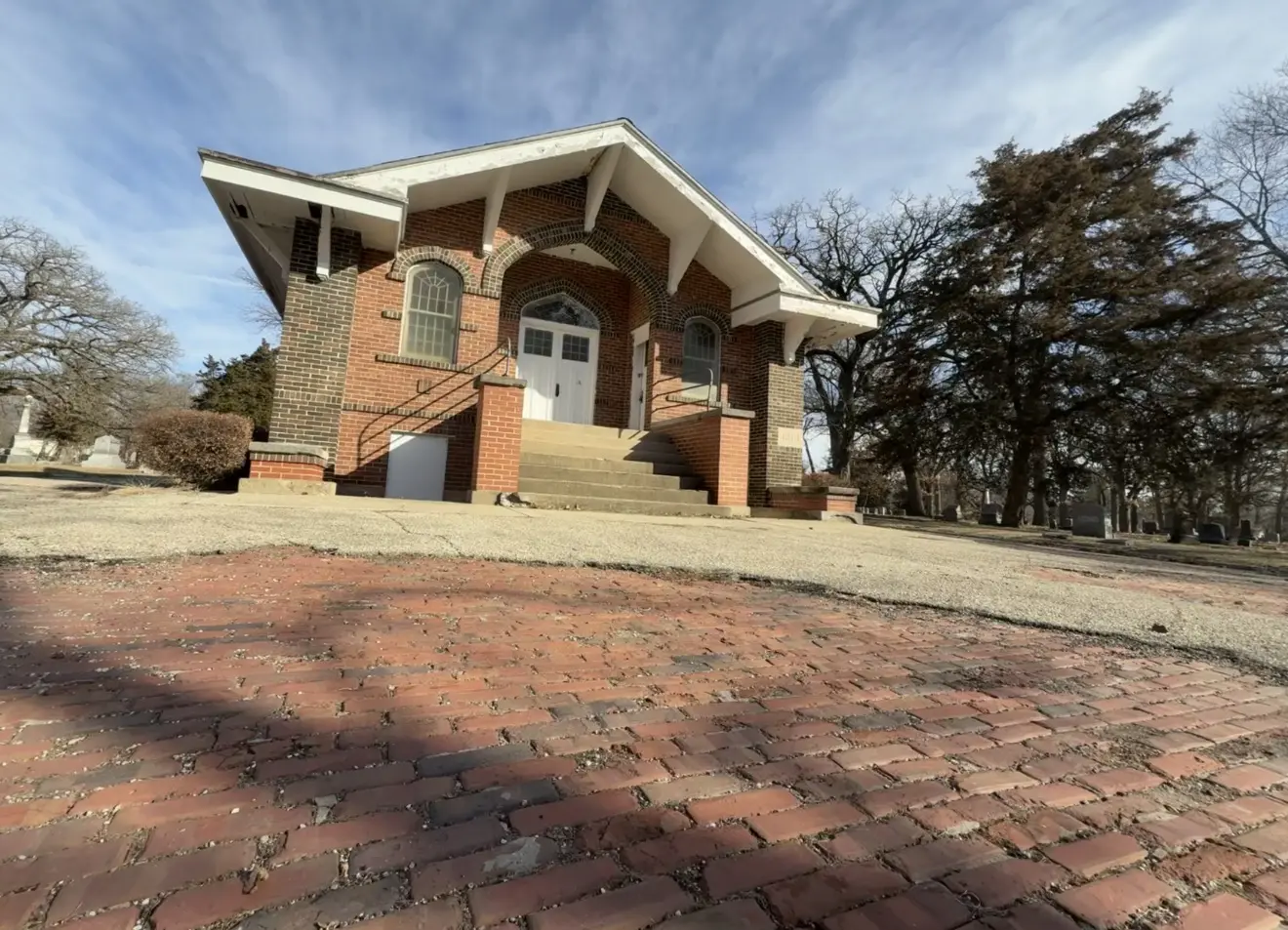
It is a small building standing near the Clary Street entrance to Oakwood Cemetery. Compared with some of Beloit’s grand historic buildings, it would be easy to underestimate it. But for more than a century, families have walked through the doors of the Oakwood Cemetery Chapel during some of the most difficult moments of their lives.
The chapel was built in 1913, but the history surrounding it reaches back almost to Beloit’s beginning. The community’s original cemetery was located on land we now know as Horace White Park. As the young settlement grew, that burial ground was abandoned and the remains were moved. In 1840, Oakwood Cemetery became the city’s burial ground. By the time the chapel was constructed 73 years later, Oakwood had already witnessed generations of Beloit history.
The architect chosen for the little brick building was Frank Kemp. Born in 1861, Kemp eventually settled in Beloit in 1899 and became one of southern Wisconsin’s most prolific architects. His obituary credited him with designing 70 churches, more than 35 school buildings and numerous public buildings and residences. His work reached well beyond Beloit, but this city contained some of his most familiar buildings, and many of them are now gone.
Kemp’s Parker School disappeared. His original Merrill School was demolished and replaced. The old city jail is gone, as is the Wilson Opera House. The Beloit country club he designed burned in 1925, and other examples of his work have disappeared with time. The little chapel at Oakwood, however, survived.
The Wisconsin Historical Society identifies the building as Craftsman in style, constructed of brick and designed by Kemp in 1913. Its size is modest, which seems appropriate for what it was intended to do. This was not a monument meant to dominate the cemetery. It was a working part of it, used for committal services where families could gather for the final portion of a funeral rather than standing entirely outdoors at the graveside.
There was another practical reason a cemetery chapel mattered in Wisconsin. In the years before modern excavation equipment, winter could make burial impossible. Frozen Wisconsin ground sometimes meant a person who died during the coldest months could not be buried until conditions improved. An account of a 2018 Oakwood Cemetery history tour led by Beloit Cemetery Coordinator Robert Pokorney II describes bodies being moved into the cellar of the chapel, where they could remain until the ground thawed enough for burial.
A funeral could be held and goodbyes could be said, but the burial itself might have to wait for winter to release its grip on the ground.
That detail makes the building something more than an attractive piece of old architecture. The cellar beneath it once served a purpose directly connected to the realities of death and burial in an earlier Beloit. For some Beloit families, the little chapel became part of that waiting.
As technology changed, so did the building’s role. The chapel eventually became the Oakwood Cemetery office, continuing to serve the cemetery long after its original function had become less necessary. The City of Beloit says it remained in use as the cemetery office until the mid-1970s, when cemetery operations were moved to Eastlawn. The chapel remained behind, beginning another chapter in a building that had already served Beloit for more than 60 years.
Today Oakwood covers 28 acres at 1221 Clary Street. Within those acres are the graves of people whose names appear throughout Beloit’s history, alongside thousands of people whose stories were quieter but no less a part of the community. The chapel has stood among them since 1913, watching the cemetery and the city around it change for more than 110 years.
That is what makes preserving it important. Historic preservation cannot be limited to the biggest house, the grandest church or the building associated with the most famous name. Sometimes a small structure tells us something about ordinary life that a grand building cannot, and Oakwood’s chapel is one of those places.
The chapel tells us how Beloit once buried its dead and what families experienced before modern cemetery equipment existed. It preserves the work of an important Beloit architect whose local portfolio has already been diminished by demolition and fire. Most importantly, it gives Oakwood something photographs and written records cannot provide: a physical place where that history can still be experienced.
Oakwood is already a place where Beloit’s history can be taught. Cemetery walks have brought people here to learn about the city’s earlier residents, and the chapel itself offers an opportunity to tell those stories. With preservation, it could continue to serve as a place for cemetery history, preservation programs and interpretation of the generations of Beloit residents buried throughout Oakwood.
Preservation does not require pretending that a building still serves exactly the same purpose it did in 1913. Good preservation can give an old building a new purpose while respecting the reason it exists. In the case of Oakwood Chapel, its future could be closely connected to its past, serving once again as a place where people gather, remember and learn.
More than 110 years after Frank Kemp designed it, the chapel is still standing. Too many of Kemp’s Beloit buildings can now be experienced only through photographs, postcards and newspaper clippings. Once a building reaches that point, no restoration project can bring back the original, which makes the buildings that remain even more important.
Someday, when someone tells the story of winter burials, Frank Kemp, Oakwood Cemetery or the generations of Beloit families who gathered here to say goodbye, they should not have to point to an empty space and explain what once stood there. Preserving the Oakwood Cemetery Chapel means they can point to the building itself and say, “It’s still here.”
About the sources
This story draws on the Wisconsin Historical Society’s architectural inventory for the Oakwood Cemetery Chapel, City of Beloit cemetery information, biographical and obituary material about architect Frank Kemp, and coverage of the 2018 Oakwood Cemetery history tour led by Beloit Cemetery Coordinator Robert Pokorney II.
Photograph by Thomas Pullen.