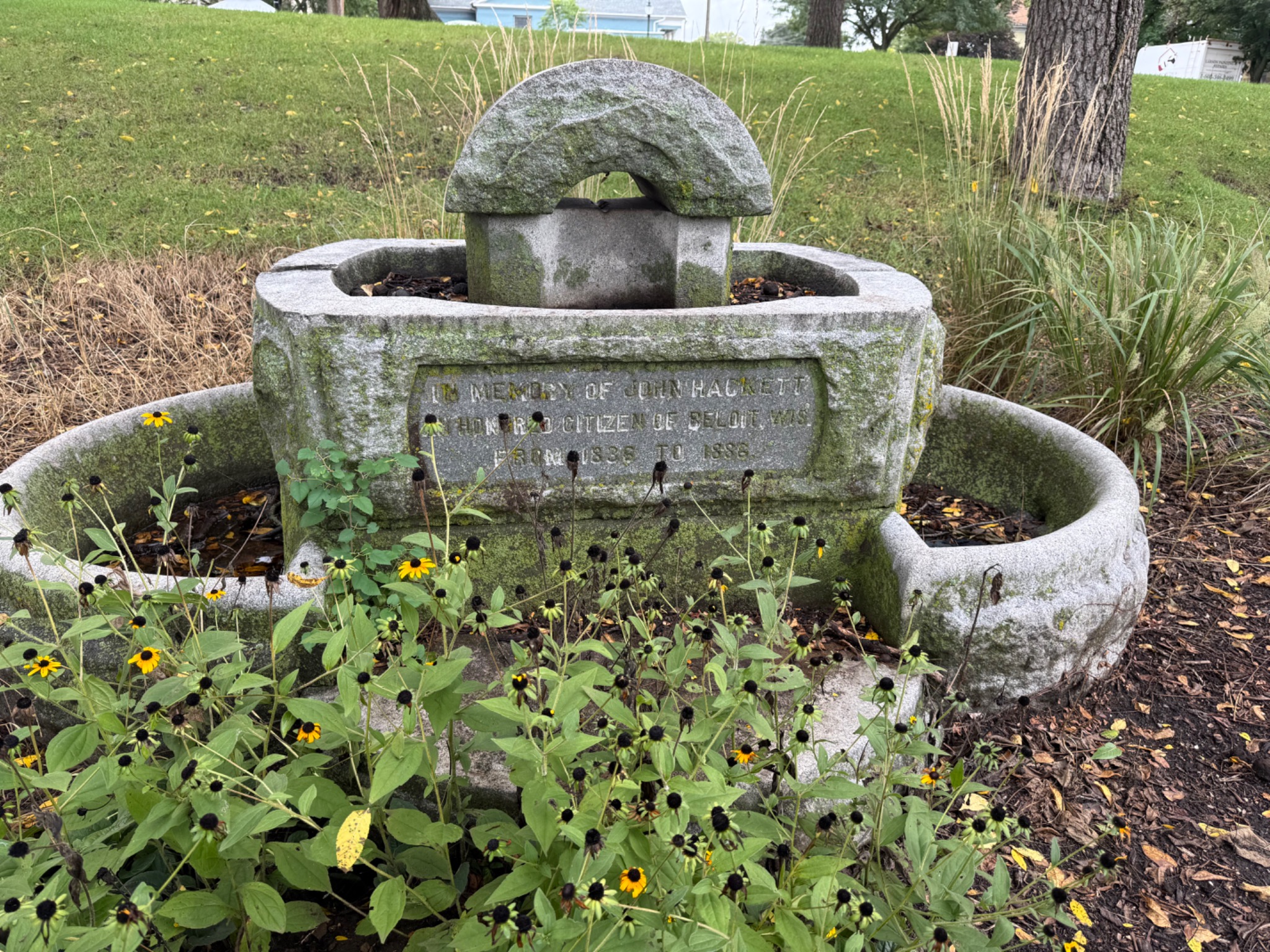
There was a time when a horse could stop for a drink in the middle of Fourth Street and Grand Avenue. The stone fountain that served it is still in Beloit, although you now have to look for it in Field Park.
Across its weathered face is an invitation that sounds strange to modern ears: “Drink both ye and your cattle and your beasts.” The broad basins make the purpose clear. This was a public watering place, built for a city that still moved by horse.
On the other side is a name: John Hackett. He was among the people who arrived here in 1836, before Beloit had its present name. Hackett married Cordelia Blodgett, daughter of Caleb Blodgett, one of the city’s earliest settlers. He became Beloit’s first postmaster, operated a flour mill, held interests in paper mills, represented the area in Wisconsin’s constitutional convention and legislature, and later served as mayor.
When Hackett died in 1886, his daughter Ella Hackett Adams chose a memorial with a job to do. On February 14, 1888, her husband, John R. Adams, presented the fountain to Beloit on her behalf at a gathering in the opera house. Mayor E. G. Smith accepted it for the city. The gift honored Hackett while giving the people and working animals of Beloit a place to drink.
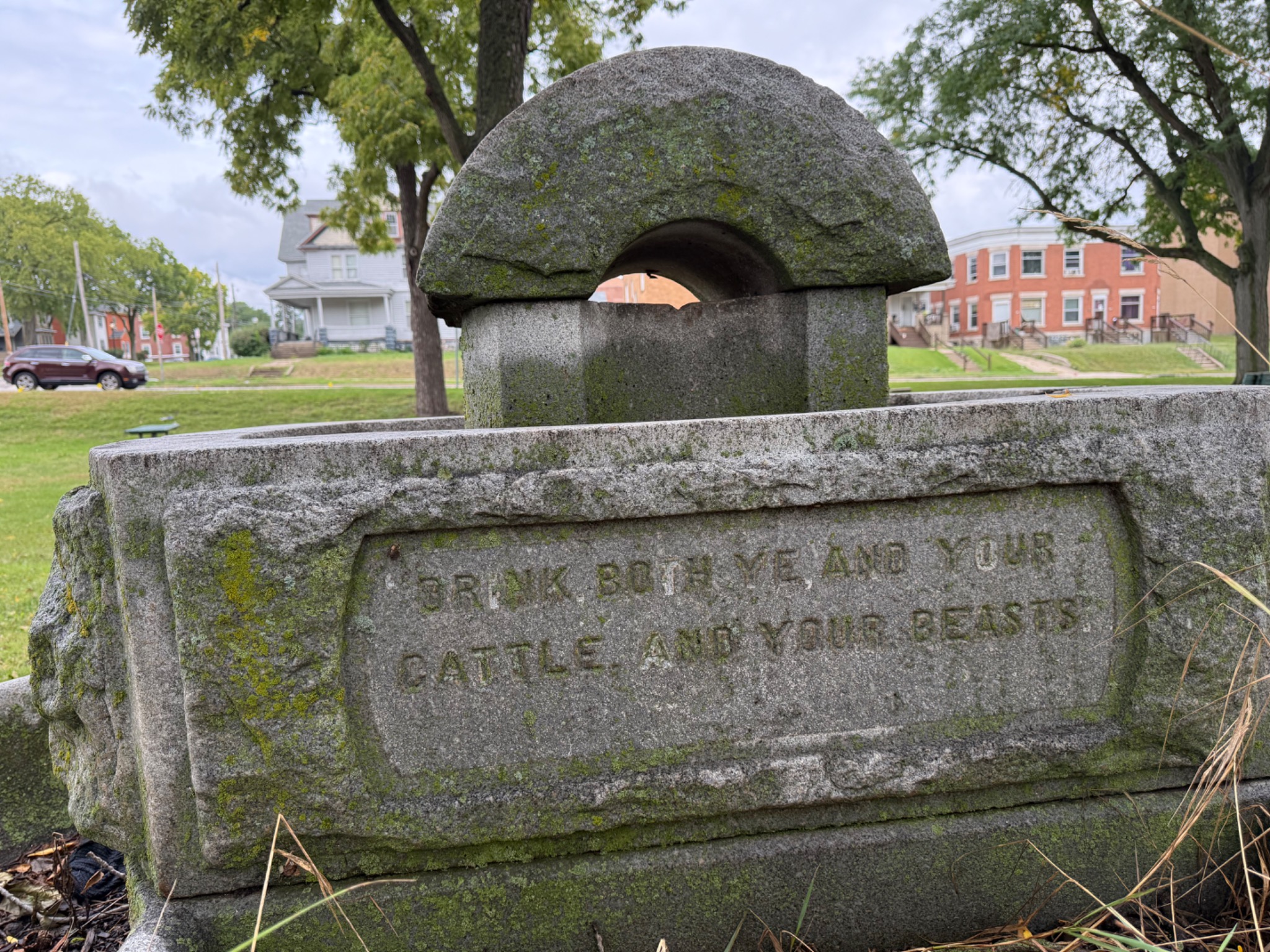
The fountain originally stood in the marketplace at Fourth Street and Grand Avenue. Imagine the sound of hooves there, and someone pausing while a horse drank from this very stone basin. Eventually the fountain was moved to Field Park at West Grand and Bluff, where it stands today. The park itself was established in 1916 as the first city park west of the Rock River.
There is a small trap in the inscription on Hackett’s side of the fountain. Its dates, 1836 to 1886, can look like a lifespan. They mark his time in Beloit, from his arrival to his death. He was born in 1808.
It is easy to see the fountain now as a curious stone object in a park. But Ella’s gift once met an everyday need. More than a century later, it still does the other job she gave it: making people stop, look closely, and remember someone who helped build Beloit.
If this story made you look twice at a familiar place, follow Living in Beloit and share it with someone who loves discovering the city’s history.
Photo and sources
Photographs by Thomas Pullen. Sources: Wisconsin Historical Society, Hackett Memorial Horse Trough; Rock County, Wisconsin: A New History (1908), vol. 2, pp. 836–839; Beloit Historical Society, Confluence (October 2011); and the City of Beloit parks plan.