In the spring of 1849, Charles H. Parker walked from Belvidere to Beloit for a job at the Barker, Love & Company reaper factory. He earned one dollar a day. Each weekend he walked home to his family, then returned to Beloit on Monday morning to begin again.
Parker had come west from New England only a year earlier. In 1850, he moved his wife, Eleanor, and their son to Beloit. Two years later, he partnered with his brother-in-law, Gustavus Stone, and began manufacturing hoes before expanding into reapers and other farm machinery.
The business became the Parker & Stone Reaper Company, one of Beloit’s most important early industries. Its factory stood near Third Street and St. Lawrence Avenue, only a short distance from the hill where Parker would build his home.
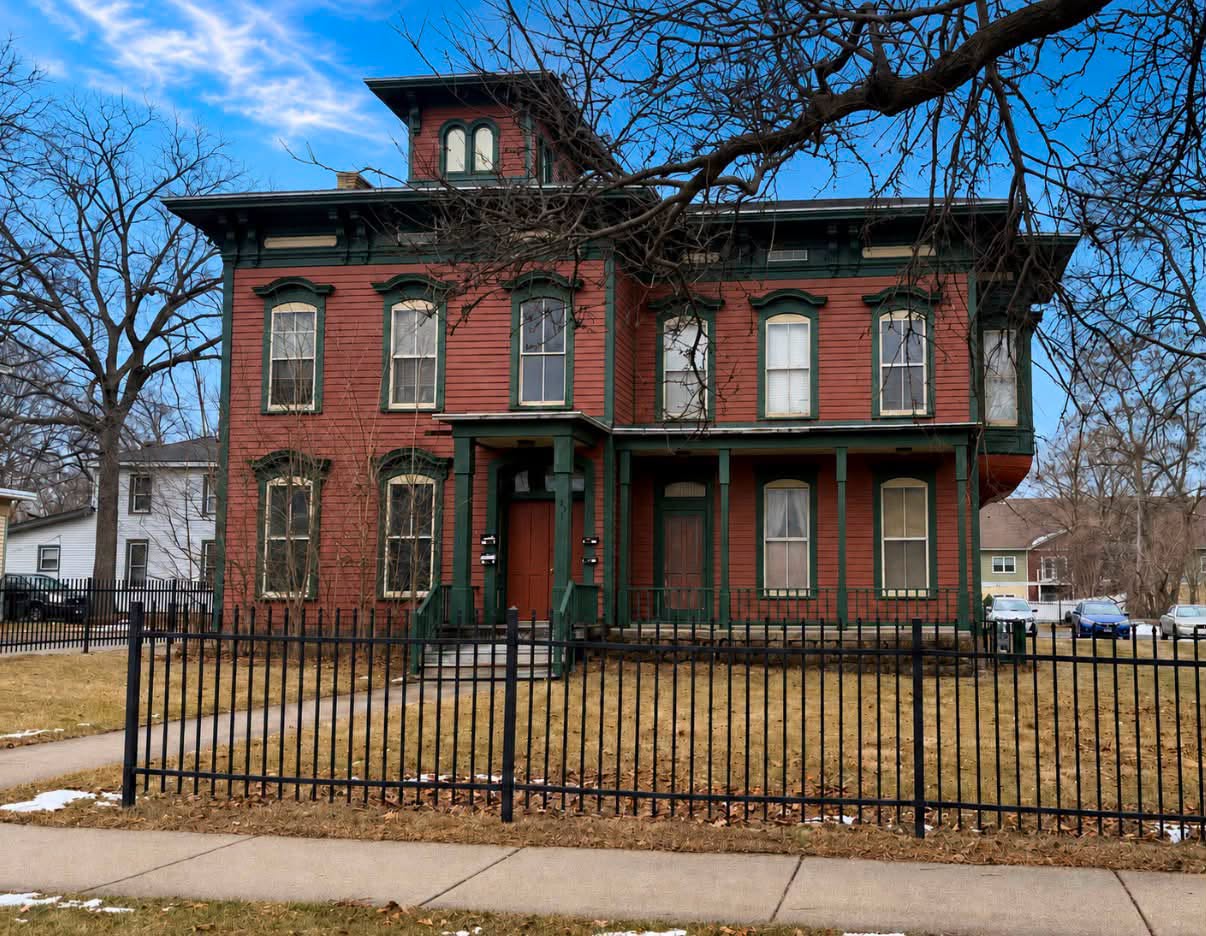
State preservation records date the Italianate house at 231 Roosevelt Avenue to the late 1850s. With its wide eaves, decorative brackets, tall windows and rooftop cupola, it must have been one of the most commanding houses in Beloit. In 1860, it became one of the city’s first homes equipped with gas lighting.
That same year, a fire destroyed the Parker & Stone foundry, including valuable machinery and patterns. Parker and Stone rebuilt, and their company eventually became part of an invention that would change American farming.
Around 1872, John Francis Appleby brought the company a model of his twine-binding machine. Early experiments were unreliable, but Parker & Stone supplied the workshop, machinery and money needed to continue. During one test, the machine tied one bundle correctly before failing on the next three.
“We’ll make it work,” Parker reportedly said. “If it will tie one bundle, it will tie all four.”
By 1878, it did. Manufacturers including McCormick and Deering purchased rights to use the Appleby binder, helping spread the Beloit-developed technology across American farms.
Parker also served Beloit as an alderman, school board member and mayor, first in 1861 and again during the 1880s. Parker School was later named for him, and in 1885 he became one of the original incorporators of the Beloit Water Company.
In 1882, Parker and his son, L. Holden Parker, helped establish the Second National Bank with other local investors. Charles served as its president until his death in 1890, and his son succeeded him.
For the next fifty years, the bank carried on with the ordinary business of Beloit. Then, on the morning of August 18, 1932, seven armed men entered the Second National Bank.
Carrying pistols and two submachine guns, they escaped with an amount reported between $40,000 and $50,000. Six women were forced outside and used as human shields while the robbers made their getaway. It was reported as the first bank robbery in Beloit’s history.
The institution Parker helped establish was renamed the First National Bank and Trust Company of Beloit in 1961. His house still stands at 231 Roosevelt Avenue, overlooking the city where a man who once walked to work for one dollar a day became a manufacturer, mayor, inventor’s backer and bank president.
Parker never witnessed the robbery. He had been gone for 42 years. But the road from that weekly walk into Beloit eventually led somewhere no one could have imagined.
Continue with the complete story of Beloit’s first bank robbery →
Photo and sources
Photograph by Thomas Pullen. Sources include Wisconsin preservation records for the Charles H. Parker House, Beloit industrial histories, accounts of John Francis Appleby’s twine binder, and historical records of the Parker & Stone Reaper Company and Second National Bank.